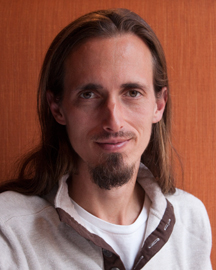
Picture of Devon

A manual should be given to us along with our body. It is one of the most amazing products of consciousness and light. As Eliphaz Levi once wrote, "light personifies itself by veiling itself, and the personification is only stable when the veil is perfect." Everything is made first of sound and light. How we get from that purely abstract place to physical reality is quite a mystery but if we can grok that relating to our body becomes much simpler.

Just when I feel like I know something about the human body, I'm shown a new way to relate to it. There seems to be endless ways. Since form affects function and vice versa, how we use it and relate to it determines how it will orient and organize itself, which affects our glands, organs, moods, and energy levels. It can be made into a vehicle for experiencing the most exquisite pleasures or into a torture chamber of unrelenting pain and agony.

If that isn't complicated enough, we have to know something about the mind. For if our minds are allowed to have free reign, they become like spoiled children or in the worst cases demons. Our thoughts and emotions eventually, if not immediately, manifest in our body. Over time, the body's shape will literally match up with the psychological and emotional make-up of a person. Likewise, we can change out physical posture and affect our thoughts and emotions. This begs the question; do we try to change our bodies or our thoughts and emotions or both at the same time? Is one of these routes easier than another? The answers appear to be quite individual. If we weren't so stuck in our point of view of self, we might find the process utterly fascinating and want to be in it and experience the process with appalling desire.

Since I have a good understand of anatomy and physiology and have an analytical mind with respect to problem solving, as a massage therapist, I can help you with injuries, physical pain, and the physiological problems that arise due to structural imbalance. My work involves extensively charting the body's alignment, determining whether structural imbalances need to be addressed outside of bodywork, and then taking care of the problems that have been facilitated due to longer-term imbalance. With this approach, I'm looking to figure out why you have chronic problems and to address them with permanent solutions.

As a yogi and a massage therapist going through my own therapeutic process, my approach to massage and bodywork is always finding new territory. Almost every technique I use, I do on myself daily. I have a daily practice of yoga, self-massage, strength work, therapeutic stretching, and meditation. As my daily practice refines itself, my approach to bodywork gets smarter, more efficient, and more elegant. I believe that there are ways to do the deepest work without going through a lot of pain and I endeavor keep in mind that the body is an intelligent system and that everything is the way it is for a good reason.

My disposition is very calm. Just being in my presence will help relax you without me doing any massage. Since I do quite a bit of yoga and meditation and have a healthy lifestyle including eating well, my vibrational frequency is high. This benefits you because being around me will help raise your frequency. This will help you with your outlook on life, your mood, and patterned reoccurring thoughts. You want to work with a therapist that is healthier and happier than you are and knows that being a therapist involves a daily practice that helps resolve not only their own garbage but also their clients' garbage. Energy moves from denser concentration to lighter concentration. The therapist should be ready to pickup some of your stuff and be able to process it. If the therapist is vibrationally denser than you, you may pick up some of their garbage.

I've been a massage therapist since August 2003. I graduated from the Central Florida School of Massage Therapy in Winter Park. I integrate the following modalities - Posturology, Therapeutic Stretching, Fundamental Integration, CranioSacral Therapy, Positional Release, Neuromuscular, Body Tuning, and Sat Nam Rasayan.

The last living master of Kundalini Yoga and the Mahan Tantric of White Tantric Yoga, Yogi Bhajan said that to really understand a subject, you have to teach it. This comment was often made with respect to Kundalini Yoga. Even though it is generally forbidden to practice or teach White Tantric, I plan to start offering classes soon. I consider White Tantric Yoga to be the most transformational practices that I have encountered. Intuitively, I feel that I should be involved in it on a more regular basis and that I should make it available to others.

While I appreciate many forms of yoga and meditation, it is Kundalini Yoga that I find myself doing the most. I'm trained as a teacher, teacher periodically, and it is a good part of the yoga I do everyday. In fact, I would say that it is yoga that got me into massage. I was into yoga almost a decade before I got into massage. When I went through teacher training for yoga, I felt that the training was substantially insufficient in training teachers to know and understand anatomy and physiology. I remember thinking that the best yoga teachers were also bodyworkers. White Tantric Yoga, which is closely related to Kundalini Yoga in the West, is what definitively led me to study massage. Doing White Tantric, I realized that many of the practitioners are also yoga teachers and bodyworkers. To really understand what was going on and get the most out of it, I felt that I needed to get into some kind of healing modality.

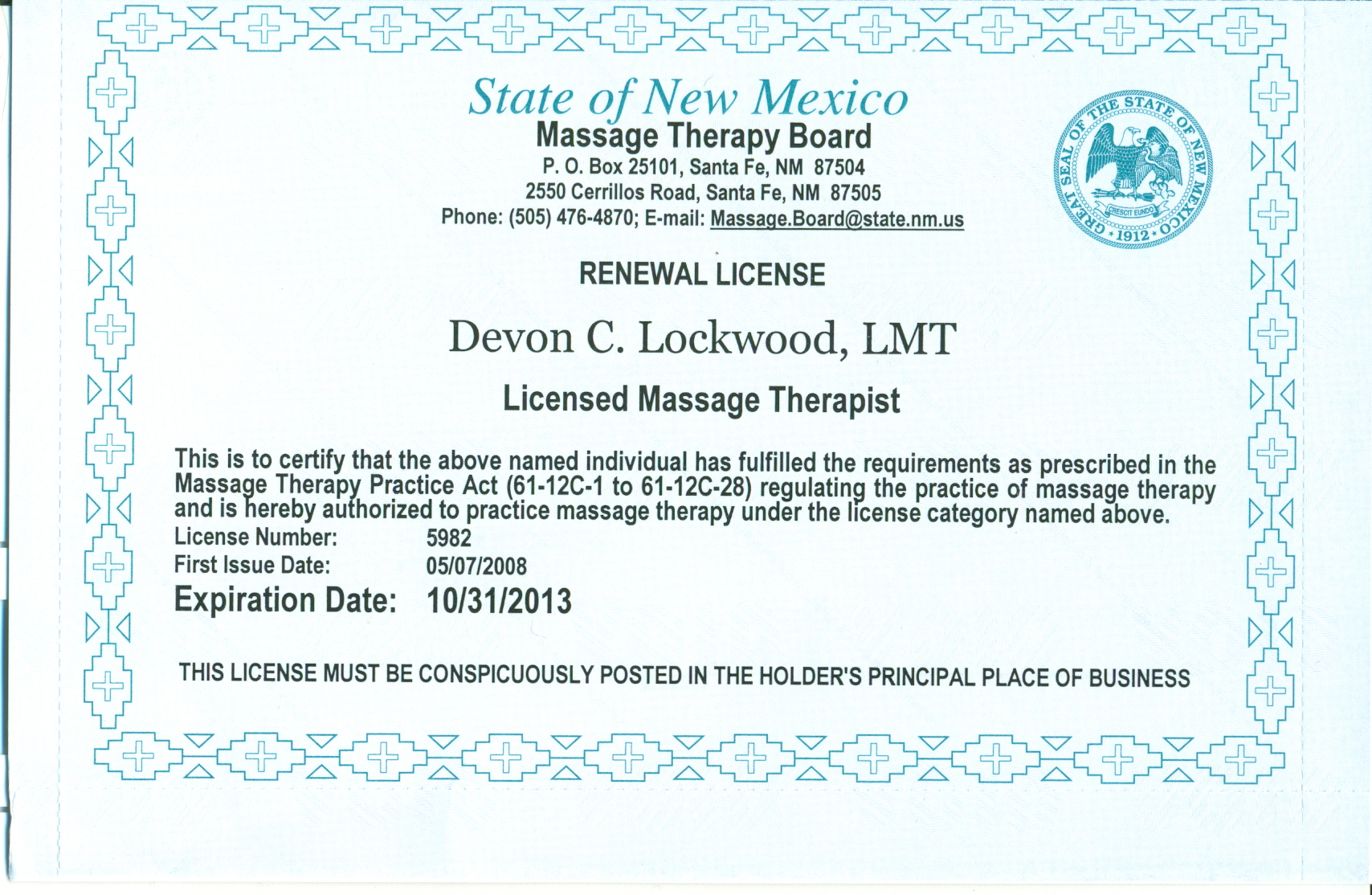
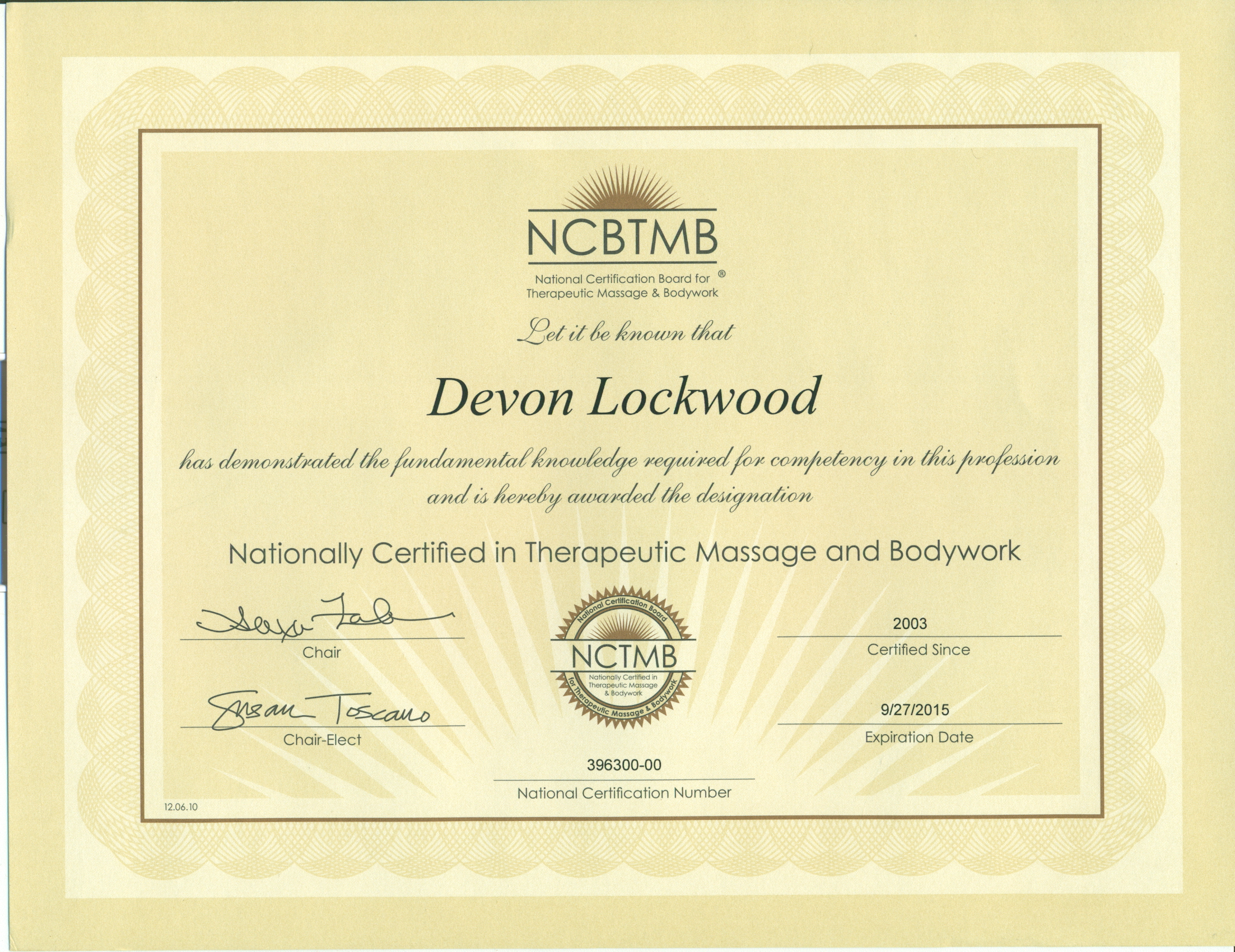
I'd like especially those Internet oriented clients to know that I am a Florida state licensed massage therapist. I am nationally certified through the NCBTMB. I am a member of the FSMTA and that all work I do is within the legal and ethical boundaries of these organizations.

Private yoga instruction: 1.5 hours - $72 (at the Kundalini Yoga Center)

Pricing for table massage:

You come to me (incall)

  • 1 hour - $72
  • 1.5 hours - $108
  • 2 hours - $144

I go to you (outcall)

  • 1 hour - $81
  • 1.5 hours - $117
  • 2 hours - $153

Chair massage: $72 per hour.

I accept cash, check, and credit(Visa and Mastercard). Note that all numbers numerologically add to 9.

There are several ways I can work with you.

  • You come to me. There are several locations I can work from.
  • I come to your home.
  • Or I come to your work place (chair massage, clothed table massage).

The best way to contact me about making an appointment or to ask about anything related to this site is by phone.

Phone: (321) 377-8725

Otherwise, you can reach me by email.

At one time, I would have said that I would love to be a professional student. I meant that in the sense of formal education. Over time and exposure to some exceptional teachers and having had some unusual experiences, my point of view has changed. I'm not saying that I no longer want to learn new things. It is quite the opposite. I want to learn and discover fresh, new things looking toward uncharted territory. I'm finding that the traditional education system (and I've had plenty of exposure to it) and what most people think of as formal education has little of any real value to offer. At best, it can give someone a starting place to begin doing his or her own research. I would like to believe that that is what I have taken from it.

I do believe in collaboration, mentorship, and leveraging what other people know in conjunction with what I find through my own self-exploration. My background is a mix of all these things, as you will find if you spend the time to further explore what is under this heading in the menu.

The Rotunda at the University of Virginia

Starting from kindergarten, I seemed to have a natural inclination for working with computers. That continued on right through high school. When I had to decide where I wanted to go to college and what I wanted to do, like most kids, I really didn't know what I wanted. I knew that I was good with computers and I'd enjoy computer science. What I really wanted was to take a break from the education system and figure out what I wanted. That didn't go over with my parents very well. So I applied to a number of schools and looked at computer science. When I got accepted to University of Virginia, I figured that it was a good enough school (ranked number 1 or 2 public school in the United States on any given year); I thought the campus was beautiful, and I saved money on it being in state.

Computer science at UVA is in the School of Engineering and Applied Science. So, I went through an engineering program. I can't say that I enjoyed college a whole lot. I was much too busy studying and staying up all night doing projects. However, it was the right place and time for me to be.

Ligmincha logo

While in Charlottesville, Virginia, I discovered a Tibetan approach to spirituality, Bon and Dzogchen, which currently has one of its primary locations right there, Ligmincha. Getting involved in Ligmincha, influenced me to study the Chinese and Tibetan languages, which it just so happens, UVA has excellent programs for these.

Adrienne and I in dance position.

When I moved to Florida to work for Federal Express (information technology), one of my co-workers wanted to take swing lessons but didn't want to go alone. He asked me to go and I didn't put up much resistance. He had chosen the John Parnell dance studio, which is somewhat well known for the father of the Parnell daughters and his ability to coax money out of people and then squander it. While I didn't learn much about dance exactly, I did meet some wonderful people that took me over to a newly forming studio called the Zebra Room.

Trish and I in dance position.

The owner of the Zebra Room, Trish Sie is an exceptional dancer and instructor. I studied as many forms of partner dancing as Trish would teach me. We mostly focused on American Rhythm and Latin. Three years later and a lot of drama, the studio, in a way, came undone. Trish started heading more in the direction of teaching children which led her to create the Snark-a-Snoops now in LA and doing quite well.

Melanie striking a pose.

One of my favorite dance teachers is Melanie Sandvig, I worked with her for two to three years and I would have continued if it were not having to down grade my spending habits along with leaving the technology field. Melanie is one of the most successful professional dancers in the Orlando area and happens to be an excellent teacher as well. She is known for her precision understanding of styling and at the same time making it beautiful. She like the neoclassical artists understands that precision geometry and creativity combined make the most exquisite beauty.

Timothy and Michele in dance position.

I moved on to work with many of the dance instructors in Orlando finding my real destination in Tampa with Timothy and Michele Mason. They aren't simply the best smooth dancers and instructors in Florida, they are known quite well internationally having originally moved here from England. I worked with Michele for a couple of years; basically until I hit the crossroads with my work as a software engineer verses a yoga teacher and massage therapist. If it were not for exceptional and supernatural events that led me to become part of the community that makes up the Kundalini Yoga Center in Altamonte Springs, I would have moved to Tampa to work for and with Timothy and Michele to startup their studio, the Easidance Ballroom.

The experiences I've had in the dance world have given me some unusual insights into movement, body mechanics, and alignment. On a personal level, it taught me a great deal about being in someone else's body space and about touch related issues that aren't taught in massages schools.

At Summer Solstice in June of 2002, I started thinking about going to massage school and not really from the point of view of working as a therapist but that it was just something I felt I should do and wanted to do. I believe it was a month later that I was talking with one of my neighbors at the Kundalini Yoga Center and she mentioned that she was planning to go to massage school. She said that she had already looked into it and that she had picked out the best school in the area, the Central Florida School of Massage Therapy in Winter Park. That September I started the night program at CFSMT. The program was 525 hours and was three to four nights a week for a year.

During my stay at CFSMT, I came to highly appreciate the work of the head instructor, Monica Reno, later to become the director of the school. She calls her approach to bodywork Fundamental Integration which is tailored primarily to athletes. She plans to teach her work in a workshop setting and has done quite a bit of work towards that end; but as yet, it has not come to fruition. So, I've worked with her as much as I can in a mentorship role. Currently, she is the co-owner of the Tuscany Day Spa in the Villages at Lady Lake.

One of the places I currently work part-time, New Directions Health & Bodywork Professionals impressed upon me the value of CranioSacral Therapy. I've taken CSTI and CSTII through Upledger. CranioSacral Therapy is a light modality focusing primarily on the nervous system and its hydraulic action. I've found that it has been very useful in conjunction with other modalities to help a person regain balance within their body.

Another modalities that is used quite a bit at New Directions is Neuromuscular Therapy which focuses on trigger points, nerve entrapment, and postural distortions. My training in this modality has mostly been informal, on the job, and self-taught.

Picture of Glenn Black

During one of my many stays at the Omega Institute in Rhinebeck, NY, I took a class with Glenn Black on his work, Bodytuning which relies on intuition, innovation and creativity to alleviate conditions in the skeletal, muscular and connective tissue systems. His influence dramatically changed my point of view on bodywork and I plan to take more of his classes.

Every six months, I go to a 3HO solstice yoga retreat. One of the many blessing of attending is being able to go to Guru Dev's Sat Nam Rasayan classes. Sat Nam Rasayan is an application of Kundalini Yoga meditative awareness toward becoming aware of imbalances in a person's body and sending energy to it giving it the opportunity for change without judgments about how or when. In essence, it is a healing modality that takes the practitioner's ego out of the equation.

My first exposure to yoga was in high school. My Mom signed both of us up for an Iyengar class in Bethesda, Maryland at the Unity Woods yoga center. My Mom made an excellent choice. The center is still around today and doing very well. I remember feeling so good after class and walking felt so different with my hamstrings loosened up. Unfortunately, we stopped going when my Mom hurt her shoulder. We were doing a decent amount of inversions in class. She has had shoulder problems for as long as I can remember. Anyway, I didn't have a driver's license at the time and while I enjoyed it, it did not resonate with me so deeply that I had to make to class without my Mom being into it, particularly at that age.

Picture of the Monroe Institute

When I was a junior in high school, my Mom attended a retreat at the Monroe Institute intended to teach participants about out-of-body experiences. My first experience of feeling compelled to do something based on intuition came when I felt that I needed to attend the same program, the Gateway Experience (now the Gateway Voyage). There are big differences between now and then and the content and intent of the program. Monroe was still alive when I went. The program was geared towards the out-of-body experience and had some powerful content. Over the years, it has gotten watered down to minimize the number and frequency of people losing their mind after having their belief system opened up. The affect of this program was profound for me, especially at the age of eighteen. I had paranormal experiences that gave me insight into my past, present, and future and it gave me some useful tools for psychic intent and protection.

Ligmincha logo

Later when I was in college, my Mom picked another class for us to go to. It was a dream practice class held in the D.C. area by Tenzin Wangyal Rinpoche. It was fascinating material and I came to find out that his home bases was in Charlottesville, Virginia where I was going to school. So, I started going to Ligmincha and learning about Yungdrung Bon, the Eternal Dharma. I became part of the local sanga and attended weekly group meditations. I went to a bunch of retreats including Ngondro 1 and 2. I got so into it that I decided to study literary and spoken Tibetan as offered by the Department of Religious Studies at UVA. I took the first two courses, got into a third and my schedule overloaded and I had to back off.

I found the practices and philosophy to be very powerful. In fact, I was experiencing substantial paranormal activity at the time, which I attribute to doing the practices. However, back then Tenzin was not very available and I didn't feel supported in my journey into the unknown with these practices. At a certain point, I really went off the map. So, I backed off and got some counseling, which ironically was with a Sikh. He didn't tell me anything about Sikhism or Kundalini yoga at the time but that was his background.

Front gates at the Kundalini Yoga Center

It found me later in Florida at the Baba Siri Chand Ashram. When I walked through the gates at the school, I thought to myself I have arrived ... where has this place been my whole life... this is where I am suppose to be. If take a few steps back, I was really into dance and was part of a formation at the Paradise Ballroom in Kissimmee. Our formation was a medley of foxtrot, tango, and waltz. We started out each class with some stretching which I really liked and it reminded me of yoga and Iyengar classes. I really was not enjoying the class otherwise and decided to start looking for yoga and heard rumors about classes in Altamonte while shopping and eating at the Chamberlains in Longwood.

I started taking Wednesday evening classes and heard about the morning Sadhana practice at 4am and quickly transitioned to it. That led me to do the teacher training in 2001. After teacher's training, I continued with the 4am practice until I hit the crossroads on whether I was going to move to Tampa and go to work for Timothy and Michelle opening up there dance studio. My sadhana experiences continued to get more and more intense until I peaked out with what very closely meets the description of a seventh chakra activation. I wonder still to this day if it wasn't a near death experience. After that, I knew that I was suppose to be at the ashram and that I wasn't moving to Tampa.

Any serious study of Kundalini Yoga in the West puts you on a crash course for Solstices and White Tantric. That is what I got into next. All other practices and meditation approaches seem like a cakewalk compared to Tantric. I have found it to be incredibly transformational. I quickly realized that it provided me with a strong sense of direction for at least three months after each event. After my second experience with Tantric, I felt compelled to go to massage school.

Rishikesh on the Ganga near Parmarth Niketan ashram

February of 2006, I went with Gurmukh and Golden Bridge to India. For years I said that I did not want to go to India because it is such an assault on the immune system. I work hard to maintain quality health and it just seemed like the risks verses the benefits did not add up. When the Gurmukh presented the idea of her trip while I was at one of her workshops at Omega Institute, the idea sat much better. She does a first class job of everything she does and I felt safe that she would point out the best places to eat. My Mom and I decided to go with her three months later.

Rishikesh on the Ganga overlooking a bridge

Our journey took us to three places, Amritsar, Rishikesh, and New Delhi. Going to Amritsar is kind of a right of passage for anyone that studies Kundalini Yoga as it is the home of the Golden Temple. We stayed in Amritsar for a couple of days before going on to Rishikesh which was our primary destination. We stayed at Swamiji's Parmarth Niketan Ashram for the International Yoga Festival held there each year. I developed great new/old friendships, fell in love with the beauty of the Himalayas, and got introduced to some powerful new energetic and geometric concepts. The overall effect of the trip was to open up my sixth chakra.

After this last Summer Solstice, June 2007, I feel drawn to teach and lead White Tantric Yoga. I plan to start offering classes soon.

Under the Modalities menu, I list the forms of massage and bodywork and in some cases influences that I integrate into my work. I'm not completely enamored with any known modality as the only means to approaching bodywork. The modalities I cover are the ones that my path has taken me to. I haven't intellectually chosen any of them outside of my life experience. While these modalities are plenty interesting, they may not be the best out there or even exactly the right ones for you. They are an expression of my experience and if you are drawn to work with me, then at least one of these or a synthesis of these must resonate with you as well. Clients and therapists often have something in common with respect to problems they have encountered in life.

Portal Pro chair massage chair

Chair massage has become quite popular in the last ten years. It makes massage fun and accessible to many people who would never get massage otherwise. There is a common misconception that chair massage is a lesser form of massage than unclothed table massage. Many people think that chair massage is just for stress relief and a feel good experience; when in fact, in some ways chair massage is better than table massage. For instance:

  • If a client is positioned correctly in a chair massage chair, their spine is lined up correctly and their head is supported in such a way that the muscles in the neck relax and stress patterns release without any massage occurring. Tables do not support the cervical curve.
  • The shoulders are very accessible in a chair such that it is easy to do range-of-motion and stretches with little fuss.
  • The body positioned in a chair, takes stress off of the low back by flexing the hips and bending the legs at the knees. People with severe low back issues, need extra cushioning on most tables.

With a little bit of creativity, almost anything can be accomplished in a chair that can be done with a table. In fifteen minutes, a lot more can be accomplished than most people would think. It is possible to get vascular, lymphatic, and cranial circulation boosted. Restrictions in major muscle groups can be addressed and the body can be realigned structurally. Obvious affects include more energy, easier more pain free movement, a stronger immune system, and a brighter outlook on the day.

From the therapist's point of view, chair massage can be more physically demanding than table massage. Clothed massage often uses with greater frequency the more strength related techniques like petrissage (lifting and kneading like with dough). This really is the only draw back. I can think of none where it concerns clients.

Anatomical chart of the cranial system

CranioSacral Therapy (CST) is an approach to bodywork focusing on the semi-closed hydraulic system of cerebrospinal fluid that bathes the nervous system, its protective tissues, and the ligament like tissue where bones come together and move with respect to each other in the cranium. The movement associated with these anatomical structures provides the nervous system with nutrition and filters out toxins. There is a great deal of physical bodywork that can be done with getting this system back into balance or into balance in the first place as the case maybe but this really is the starting ground for CST. Going into deeper territory, the nervous system is used as a diagnostic for delving into energetic, emotional, and psychological issues that drive dysfunction that may occur on any level.

CST has been shown to be effective at treating a wide range of medical problems.

  • Migraine Headaches
  • Chronic Neck and Back Pain
  • Motor-Coordination Impairments
  • Colic
  • Autism
  • Central Nervous System Disorders
  • Orthopedic Problems
  • Traumatic Brain and Spinal Cord Injuries
  • Scoliosis
  • Infantile Disorders
  • Learning Disabilities
  • Chronic Fatigue
  • Emotional Difficulties
  • Stress and Tension-Related Problems
  • Fibromyalgia and other Connective-Tissue Disorders
  • Temporomandibular Joint Syndrome (TMJ)
  • Neurovascular or Immune Disorders
  • Post-Traumatic Stress Disorder
  • Post-Surgical Dysfunction

I have studied CST I and II through Upledger's organization. While it provided me with a strong repertoire of tools and an anatomical understanding of the nervous system, it did not impact my approach to bodywork strongly until about six months ago (beginning of 2007). For years, I had been experiencing a growing level of dysfunction on my right side particularly in my head. With the help of Kundalini Yoga, I changed the fact that I could not breathe through my nose but that did not get to the core issue. As things got worse, I noticed that I had less enervation to my right eye, the right side of my back was getting chronically tight, and my right leg tended to fall asleep when I would meditate. Near the beginning of 2007, I taught myself a technique based on yoga and bodyworking principles, with cranial therapy in mind, to affect my dural tube strongly in such a way that many of these symptoms radically changed for short durations of time. I have since found that Paul St. John has an excellent approach for dealing with this and that is what I now use. His organization at one time worked very closely with Upledger but since they split off, his cranial approach has differentiated by being structurally based while the Upledger approach is physiologically based. I highly appreciate both approaches and will study further with both organizations.

Picture of Glenn Black

Body Tuning is a form of bodywork based on western physical therapy, yoga, osteopathy, acupuncture, tai chi chuan and reflex therapy. The most well known practitioner of Body Tuning in the Unite States is Shmuel Tatz based out of New York. I got exposed to this work from one of his best students and co-workers Glenn Black. I attended a workshop Glenn Black held at Omega Institute.

From my experience of the work, it is a clothed table modality. It involves a great deal of movement, intuition, and understanding of anatomy and physiology. The work is very efficient often working on two or three parts of the body at the same time. The idea being that if you can distract the client sufficiently, they won't be able to resist, hold onto unconscious patterns, and block efforts to loosen up and rebalance the areas being worked on.

It is very difficult, to say the least, for someone to do this work the way Glenn Black or Shmuel Tatz does it without having done bodywork for decades. They multitask so much and are so efficient that they accomplish in fifteen to thirty minutes what most therapists cannot accomplish at all or at least without doing months of sessions with a client. Having said that, there are still so many things that can be learned from the Body Tuning approach and integrated without being that talented. It shifted my point of view on bodywork considerably and it gave me a new guidepost to try to reach. It took me a couple years to digest what I was shown in that workshop. In August, I'll take another workshop at Omega with Glenn Black.

Fundamental Integration is form of myofascial bodywork that Monica Reno has come up with based on her more than twenty years of experience providing massage to athletes. She has tremendous knowledge in anatomy and physiology. Her palpation skills concerning fascia are unmatched. This work tends to be very structurally oriented taking into account how misalignment occurs in the body with respect to oppositional muscles. Much of the work focuses on appropriately separating muscles and the surround fascia such that muscles are fluid and capable of their maximum strength and that they can fire independently as needed as opposed to firing groups. The benefits include more energy, feeling lighter, being able to runner, bike, swim, etc. faster and longer with less effort. The body works more efficiently after receiving this work.

I seem to be the only one writing about this work on the web even though it is Monica's intention at some point to teach this work widely. She has her hands tied up right now with her spa, the Tuscany Day Spa in the Villages at Lady Lake. In fact, I believe that she has cut way back on doing massage herself.

Most of my knowledge of her work is based on watching her work and participating in the training for a study she conducted comparing her work with Swedish massage on runners preparing for a marathon. At this time, the results of that study have not been published or made available. Anyhow, a good part of my work is modeled after watching her work and observing her body mechanics.

Posturology is the study of posture. My training is through Neurosomatic Educators based out of Tampa Florida. It is Paul St John's approach to charting the body, such that the structural imbalances become apparent. It also provides a standard to measure therapeutic progress.

Below is an example of the charting I do. Measurements are taken standing, lying down, and sitting. Generally, the body should be treated based on imbalances that are present during standing. Because the body is always trying to keep the eyes level with the horizon, it bends, twisting, and rotates in whatever way it needs to right the eyes. If our eyes are not level, we experience vertigo and cannot do anything. In nature, we would become prey. So, keeping the eyes level, the righting reflex is a top-level priority and gravity has everything to do with how that works. When lying down, most if not all imbalances should correct. When they do not correct, we call them a fixation. Bodywork and massage are particularly good at correcting fixations. If the body goes into dysfunction in a new way when lying down, we call that a subtle proprioceptive mechanism. It indicates that the person needs visceral work; one of their organs is under unusual stress. I can also get a pretty good idea of whether there is a leg length imbalance from the lying down measurements. Taking measurements while a person is sitting allow me to determine if their hips are equal in size.

In the example below, the person's hips have gone into an oblique position, the right ilium is flaring in and the left is flaring out. Typically when this happens the temporal bones in the head go into an oblique position in the opposite way. As goes the hips, so goes the head, in an opposite way. When obliqueness is present and unaddressed, no other bodywork will stick and provide lasting results. Obliqueness locks in place most imbalances.

The person below has a smaller right tibia and fibula, lower leg, and a smaller left femur, upper leg. Between the imbalances in both legs, they are equal. At first it appears noteworthy but it turns out not to be causing any problems.

From the sitting position, I determined that the right ilium is smaller than the left. First, I take all the measurements. Then if the hips are out of place and I suspect a leg or hip length/height difference, I will put the hips into a balanced position and then see how much lift is required under one of the feet and/or hips to put the body into structural balance. In this case, the person needs a 7 mm lift under the right foot when standing and a 7 mm lift under the right sit bone when sitting to prevent the imbalances I've charted from occurring.

Example Posturology Chart

I see that the left foot has a fallen arch. This is part of the body's compensation for trying to cope with one side being bigger than the other. Likewise, the left hip rotates into a negative position allowing the head of that femur to be higher, making the leg functionally a little shorter. The right side of the body in this example is projecting, tilting forward. With all of the compensations that the body is doing, it has actually made this person's body functionally smaller on the left side and as a result, the right is rotating and tilting forward. Generally when in balance otherwise, the body will rotate and tilt forward on the bigger/longer side.

When the body is structurally in balance, the left and right sides are even and level when the person is standing up in the three planes, sagittal, coronal, and transverse, correct posture comes natural. It does not require effort or special awareness. When a person has bad posture, it usually is not their fault. It isn't because they are lazy. They, in fact, have to work very hard to deal with all of their imbalances. The body has more energy and is more efficient when it is in structural balance. Further, form affects function. The organs and glands, and in fact all physiological aspects of the body, work better when there is structural balance. For example, when one side of the body is more out of balance than another, it is not uncommon for the associated armpit to produce less favorable scent. Quality of scent is, in general, directly related to structural balance. From the point of view of nature, it makes complete sense. Survival of the fittest and mating is driven by scent. Another example of form affecting function is that when a person has a smaller hip on one side and obliqueness increasing towards its maximum, a person can experience dyslexia. The bones in the head should move oppositely from the hips. When the bones in the head get out of balance enough, parts of the brain do not communicate with exact precision. Memory has very specific positioning. When the bones in the head go out of balance, the brain's ability to calculate correct positions for certain types of memory is effected.

Neuromuscular Therapy is a form of deep tissue work that focuses on pressure points. When specific pressure points are desensitized or released, they relieve referred pain in other parts of the body.

Neuromuscular Therapy works with five types of imbalance that occur within the body.

  • Ischemia: Lack of blood supply to soft tissue
  • Trigger Points: Specific pressure points in muscle tissue that refer pain to other parts of the body
  • Nerve Compression or Entrapment: Pressure on a nerve by soft tissue, cartilage, or bone
  • Postural Distortion: Imbalance of the muscular system resulting from the movement of the body off the longitudinal and horizontal planes
  • Biomechanical Dysfunction: Imbalance of the musculoskeletal system and the incorrect movement patterns that go with it

I've been working part-time for a clinically oriented massage establishment called New Directions Health & Bodywork Professionals since May of 2004. They place a strong focus on Neuromuscular and CranioSacral Therapy. Working there has been a driving force for me to get to know both of these modalities.

The concept behind Positional Release is really quite simple. Position the body such that for a given area where there is hypertension or pain, stress is taken off of that area and it is allowed to reset. For example, if there is pain and tightness in the upper part of the shoulder, the trapezes or levator scapula, the therapist makes sure that the client is not helping and lifts the shoulder up and in towards the head. The therapist can now work on those muscles and have them release easily with very little pain. Another good example is the position a chair massage chair holds the head and neck. The muscles in the neck and at the base of the skull automatically begin to release. Ideally this approach is always used. However, it is not straightforward as to how to position the body to release stress on certain muscles or groups of muscles. I try to use this approach as much as possible.

Sat Nam Rasayan is an application of meditative awareness cultivated by Kundalini Yoga. By becoming increasingly aware of what the various aspects of their own body, mind, and emotions normally feel like and how they feel different when in the presence of another person, the practitioner can know things about other people, particularly imbalances. By putting awareness on and providing energy to imbalances in the client, the practitioner provides an opportunity for change, without judgment as to how or when the change will occur. This practice takes the ego out of the equation for the practitioner.

Energetically speaking, characteristics in individuals follow from people who strongly embody them to those that don't, as they spend time together. It is similar to one of the laws of thermodynamics. When a hot body is brought into contact with a cold body, heat follows into the cold body until both bodies reach equal temperature. Character traits, emotions, intellect, physicals imbalances, really anything works likewise on an energetic level. An easy way to notice this is with speech patterns. When two people send a lot of time together, they tend to talk and think alike.

The yogi takes advantage of knowing this in that they notice the shifts that occur when they are around a given person or environment. The shifts in their own body due to external factors tell them a great deal about their surroundings. This is essential how the practice of Sat Nam Rasayan tunes into problem areas. With awareness steadily put on a problematic area, the additional energy and the perception provide an opportunity for change. In fact, just from the point of view of perception, change occurs. Science and medicine are becoming increasingly aware that perception shapes reality. By observing a thing, the observer becomes a co-creator. How they view the object, their karmic view on reality, contributes to changing the object or putting greater emphasis on its next manifestation being similar to the last. Merely observing a thing can change it.

Sat Nam Rasayan is an art of energy and awareness.

I'm finding that the best bodywork results are achieved by applying just the right stretch for a given problem. Many people have told me that they get the best, most lasting results from Thai massage. Since Thai massage is mostly stretching that statement makes a great deal of sense to me. I think that even better results can be obtained. Most Thai therapists are doing the same routine on everyone, every time. I believe in applying a great deal more specificity. I do not limit myself to any particular approach to stretching.

I highly appreciate Aaron Mattes's Active Isolated Stretching. I use some of his stretches. I particularly like his psoas stretches.

Having a substantial exposure to yoga, I draw upon my understanding of asanas for specific therapeutic results. One of my favorite stretches comes from the second series of Ashtanga yoga, Parighasana, the Cross Beam of a Gate Posture. It opens up the low back one side at a time like no other approach I know. By the way, this is the final version of the posture. Anything approaching this also produces results therapeutically.

Picture of Parighasana

I've come to really appreciate using Thera-Bands for stretching and strengthening. The Thera-Band products provide quick, easy ways to work on otherwise hard to get to areas like the sides of the hips and the tensor fasciae latae muscle, for instance. I've recently added a number of Thera-Band exercises to my daily routine. One of my favorites is stretching the fingers apart. We mostly use our hands for gripping. The muscles in the hands and forearms become unbalanced based on over use in flexing. I put my hands one at a time into a Thera-Band with the fingers together and then stretch my fingers apart repeatedly. Also, I think using Thera-Bands to strengthen the back of the neck and stretch out the front is one of the best ways of addressing a reverse cervical curve, or military neck.

Yoga in all of its traditions and forms has a long and mysterious history. Many people claim that yoga came out of India but I view that the same way I do the Great Pyramid in Egypt. The Egyptians claim that it is part of their heritage but I'm pretty darn sure they did not build it and it predates their culture significantly. As far as I know, the oldest tradition including yoga is 20,000 years old and originates out of Tibet. But that is still a drop in the bucket in terms of the history of humanoids being on this planet. Yoga is perhaps as old as we can imagine back across civilizations that have lived on this planet and have yet to be recognized by the Western world and its warped idea of history. When you try to even conceptualize the origins of yoga, you get into the hairy territory of gods, aliens, and immortals. Strangely, this topic is given very little attention. It seems that when someone writes about it or has anything to say they either go into the everything is wonderful New Age point of view or the world is coming to an end mental break down. This makes it very easy to stop thinking about it and come to the conclusion that it is just a bunch of crap crazy people think about. I could write more specific things but I'm in jeopardy of you tuning out.

What we do know about yoga is that it helps us to make friends with all of the divergent parts of self. It provides a sort of reset button where we can in a healthy way temporarily check out of our various types of neuroses. It helps give us clarity on relationships and where we are going in life. It provides an approach to managing the physical body and balancing and tuning its systems.

I have experience with all of the types of yoga I discuss except Anusara. I include it because I know a bunch of people who are into it and why they appreciate it so much. It seems worth mentioning.

Anusara Yoga®, created by John Friend, combines elegant Universal Principles of Alignment with an uplifting Tantric philosophy. This innovative and heartfelt approach has made this the fastest growing form of hatha yoga. -Gina Minyard, anusara.com administrative assistant

Evidently the people running the Anusara organization are keeping a close watch on what people have to say on the Internet about Anusara.

I have started taking Anusara classes somewhat on a fluke. I can see why people like it so much. With all the upward and backward movements, Anusara opens and stretches the body in ways that counter our everyday habits. Generally, we go about reality relating to it downwards and forwards. The muscles on the front of the body are normally held in short positions while the muscles on the back of the body are held in elongated positions. When a muscle is held in a stretch for any period of time, we experience pain at its attachment points, particularly the smaller ones. So, upwards and backwards is totally what we need therapeutically.

I am not sure what is so Tantric about this yoga but it is definitely good for the body.

Ashtanga has been made popular in the last twenty years by popular names like Sting and Madonna. Its origins trace back to the early 1900s. The current living Guru of Ashtanga is Sri Pattabhi Jois.

Ashtanga focuses primarily on asanas with some instruction on breathing. Asanas are held for five long deep breathes followed by variations on the Sun Salutation, Surya Namaskar as a means of transition from one asana to the next. There are six series to Ashtanga with the idea that one series is practiced per day followed by a day off. The beginning and end of every series is the same. The asanas in the middle are different from series to series and the order of the asanas is very specific. From one series to the next, the difficulty of the middle asanas gets substantially more challenging. Most people that practice yoga have trouble completely doing the first series; very few students practice even part of the second series. Ashtanga is a wonderful overall workout providing the benefit of opening up the body's energy channels. This is an excellent practice for people that need strong structure, reliability, and few surprises.

I got into practicing Ashtanga about a couple years before I moved into the Baba Siri Chand Ashram. I was going to Lewis Rothlein's classes. He now has his own studio, Full Circle Yoga and that is where I recommend going to classes if you are interested this form of yoga. When I moved into the ashram, the director of the ashram was into doing Ashtanga. So, I was doing it there as well.

When I went to massage school, my whole point of view on yoga changed. My new understanding of anatomy and physiology made me aware that when muscle is torn up the body replaces it with connective tissue not new muscle tissue. I realized that I had been approaching yoga like going to the gym and lifting weights and had missed the point that I'm suppose to be doing something good and kind to my body. I also realized that technically stretching does not occur in Ashtanga Yoga. Rather, eccentric contraction occurs. By that I'm saying that stretching occurs when there is no load on the muscle being lengthened. In Ashtanga, almost all poses involve balancing the body against gravity and using the muscle that is being lengthened. This is an inherently injury prone approach and requires a great deal of care and honoring the limits of one's body.

I do not currently practice Ashtanga Yoga but I do use some of the asanas from time to time.

Breathing

The importance of conscious breathing cannot be stressed enough. There isn't a single aspect of life that isn't affected by the quality and depth of breathing. The ability to master reality is directly related to dynamic, conscious breathing.

I'm going to talk about a number of types of breathing including exercises related to some of them but first it would be useful to cover breathing volume and capacity.

Breathing Volume and Capacity

breath volume chart

There are four types of lung volumes, medically speaking. The volume of air moved in a single average, daily breath including inhale and exhale is referred to as tidal volume. It is about 1 pint or 500ml in a healthy person. The remaining capacity of lung volume that air can be inhaled with more effort is about 3,300ml or 3 1/2 quarts and is referred to as inspiratory reserve volume.

There are four types of lung volumes, medically speaking. The volume of air moved in a single average, daily breath including inhale and exhale is referred to as tidal volume. It is about 1 pint or 500ml in a healthy person. The remaining capacity of lung volume that can be inhaled with more effort is about 3,300ml or 3 1/2 quarts and is referred to as inspiratory reserve volume.

The remaining lung capacity that can be exhaled after a tidal volume is about 1000ml, called expiratory reserve volume. Since all the air in the lungs can never be completely exhaled without collapsing the lungs, there is what is called the residual volume, which remains in the lungs after a complete exhale and accounts for about 1200ml of air.

There are four lung capacities. The total average lung capacity is about 6000ml and is, not surprisingly, called total lung capacity.

The vital capacity is the total amount of air that can be breathed in and out and accounts for 4800ml of air. In yoga when we refer to the complete breath (which I will talk about later), we are talking about breathing that uses the entire vital capacity.

The inspiratory capacity is the total amount of air that can be inhaled and accounts for 3800ml (combination of tidal volume and inspiratory reserve).

The functional residual capacity, 2200ml, is the expiratory reserve and residual volume combined. This is the amount of old air mixed with the 500ml of new air that comes in with the normal tidal volume. Did you catch that? New air is mixing with more than 4 times the volume of stale air. It gets better. The 500ml inhaled with the tidal volume passes through 150ml of dead space, called anatomic dead space, which is the air-filled space taken up by the airways, nasal passages, pharynx, larynx, trachea, right and left bronchi, and the branches of the bronchial tree that lead to the alveoli. Gas exchange of oxygen only occurs in the alveoli. So more accurately, the tidal volume is not 500ml but actually 350ml of air when taking into account dead space. Right away, you might be able to imagine how conscious breathing can make dramatic changes in blood chemistry with respect to oxygenation levels.

Constricted Thoracic Breathing

constricted thoracic breathing diagram

The average somewhat healthy person breathes most of the time in the mid to upper chest shallowly. The diaphragm does not get much movement because the abdomen is stationary and almost no effort is put into exhaling. The action of inhaling takes place with the muscles between the ribs, the external intercostals muscles. There are opposing muscles in the ribs called internal intercostals muscles. They are used only when effort is put into exhaling. Because there is a biological vacuum in the chest cavity, the exhale in this case requires no effort.

Shallow chest breathing or constricted thoracic breathing results in stimulating a chronic but slight over stimulation of the sympathetic nervous system resulting in increased heart rate and blood pressure, problems with digestion and elimination, and cold and clammy hands and feet.

Another drawback of constricted thoracic breathing is that most of the airflow through the lungs occurs in the upper portion of the lungs. When we are in an upright position, the part of the lungs with the most blood flow is the lower portion because the lungs get blood flow from the pulmonary arteries or the venous system, the veins (the labeling of blood vessels around the lungs and heart is a bit confusing). The pressure in the veins is about 14Hg whereas the pressure in the arteries is about 100Hg. The middle and upper parts of the lungs aren't provided with the same quality of blood flow as the lower portion. So when we breathe shallowly in the middle and upper chest, we are bringing the fresh air to most poorly supplied part of the lungs with blood.

Empowered Thoracic Breathing

empowered thoracic breathing diagram

When engaged in aerobic exercise like running, the most common form of breathing is expanded or empowered thoracic breathing. With the heart beating faster and pushing more blood, the pulmonary arterial pressure is sufficient to perfuse the entire lungs with blood. There is nothing wrong with this type of breathing during exercise. Most of the work being done by the muscles of breathing is the intercostals muscles between the ribs. This can only be improved by adding more involvement with the diaphragm.

diagram of the diaphragm

Anatomy of the Diaphragm

The highest quality forms of breathing involve the diaphragm muscle. It is a rather unusual muscle for many reasons. It acts as a separating sheath between the chest cavity and the abdominal cavity. It spans the entire torso and is composed of both muscle and tendon. Its central dome is composed of tendonous material that attaches only to the muscular parts of the diaphragm. Its tendon is the only tendon in the body that does not attach to bone. Its rim attaches to the base of the rib cage and to the lumbar spine in the rear. It is shaped like an umbrella except that it is deeply indented by the vertebral column. Because of its unusual shape, its location, and where it attaches, it can move the central tendon of the dome, the base of the rib cage, the lumbar spine, or any combination of the three.

Belly Breathing

abdominal diaphragmatic breathing diagram

Belly breathing or abdominal breathing is the first type of conscious breathing to focus on. This is the training ground for the more advanced types of breathing. In abdominal breathing the most important thing to focus on is making sure that the stomach extends out when you inhale and presses back in towards the spine when you exhale. The diaphragm extends down into the abdominal area and the organs move out of the way, down and out. One of the benefits of this type of breathing is that the organs get a little massage.

The next thing to focus on is making sure that breathing is smooth, quiet, and unbroken. One way to think about this is to imagine breathing as being elliptical, as air flows in and out and you transition smoothly from inhale to exhale. By maintaining continuity between inhaling and exhaling and exhaling and inhaling, the diaphragm is always kept in motion and actively engaged. One of the benefits of this is that the lymph fluid, which is part of the immune system and constitutes a good part of the fluid in the body, is moved by muscle contraction, most significantly the diaphragm. This strengthens the immune system and helps keep it in proper motion. When you pause between inhale and exhale or exhale and inhale, the diaphragm can go slack. When movement restarts, the diaphragm muscle jumps a bit as it is engaged. This makes for uneven, irregular breathing.

Quiet breathing is important for calming the mind and gaining control over it, particularly in meditation. Ideally you should not hear your breathing unless you are engaged in aerobic activity.

Thoraco-Diaphragmatic Breathing

thoraco diaphragmatic breathing diagram

Once smooth, quiet belly breathing is well understood and in practice, it is time to move onto learning to breathe with the best movement of the diaphragm. Attempting to learn thoraco-diaphragmatic breathing first tends to creation confusion between proper breathing technique and one of the worst forms of breathing, paradoxical breathing (which I didn't cover). Belly breathing is great for beginners but over the long run, it produces an overly relaxed, depressed state; whereas, constricted chest breathing produces anxiety and high blood pressure. It is must better to be in the middle. Naturally then the focus of breathing should be centrally located in the torso right at the lower border of the rib cage. You can call this thoraco-diaphragmatic breathing or true diaphragmatic breathing.

Proper movement of the diaphragm involves a lifting up and out movement like lifting the handle of a bucket. When not exerting extra effort for a more aerobic experience, most of the movement of the diaphragm should be at the base of the rib cage like a spreading and opening of the lower border of the rib cage. The lower abdomen should have some isometric tension as well as the upper chest. In this way, the central tendon of the diaphragm moves up and down but less so that belly breathing. With chest breathing the external intercostals muscles provide the spreading of the ribs. Here it is because the diaphragm is making it happen. This is subtle but very different.

modified cobra pose

You can experience this type of breathing in a modified cobra pose. Lying on the stomach, the hands are clasped behind the back and pulled taut. You arch up to the sky while keeping the lower extremities tightly engaged. Breathe deeply. You'll notice that it is difficult to breathe in either the upper chest or the stomach. With each breath, the upper body lifts up and down a little and the base of the rib cage spreads. This is, in general, a good exercise to strengthen the diaphragm to breathe in this way. This is true diaphragmatic breathing!

Full Complete Breath

Full complete breathing is a variation of diaphragmatic breathing that also involves the intercostals muscles, the scalene muscles, the serratus muscles, and an increased action in the abdomen as well. The goal is to use the entire vital capacity of the lungs, 4800ml, complete inhale and exhale. This action starts with the abdomen extending out, then an expansion of the low back near the kidneys, followed by the mid chest and the sides of the chest, and then upper chest all the way up to the collar bones and first ribs. On the exhalation the reverse happens.

Full complete breathing is both cleansing and energizing. In one minute, the overall ventilation can go from about 4200ml to 14000ml. After about six breaths your blood gases will have shifted. Arterial oxygen will have moved from 100mm Hg to 120 mm Hg and arterial carbon dioxide from 46 mm Hg to 35 mm Hg. There is more oxygen in the blood and less carbon dioxide. Everything in the body works better with more oxygen.

Hyperventilation

That brings us to an interesting point. You can't get too much oxygen into your lungs when breathing but what happens when carbon dioxide levels get too low? It is called hyperventilation. Carbon dioxide has an important function in the body. It gauges the flow of blood through the small arteries and arterioles of the brain and spinal cord like a spigot on a water hose. As carbon dioxide levels decrease arterioles constrict and limit blood flow to the tissue. Oxygen levels are irrelevant in this case. When carbon dioxide levels get too low, we pass out and lose consciousness.

In yoga we use various forms of breathing that are more intense than normal breathing. It should be emphasized that the student should only put as much effort into such exercises such that they remain below the threshold of hyperventilation. This rarely occurs. Most students couldn't put enough effort into their breathing. But it should be noted that the student works themselves up to greater and greater levels of ventilation allowing the body to become accustomed to lower levels of carbon dioxide.

Breath of Fire

When we talk about breath of fire or bellows breath, it is not hyperventilation. A simple way to think of this type of breathing is that it is fast belly breathing through the nose. Students should only do breath of fire at a pace that balances inhale and exhale and can be done for more than a couple minutes without getting lighted or dizzy. Speed and effort should be increased over time. This way the benefits of alertness and well being associated with higher levels of blood oxygen can be experienced.

I've been doing breath of fire daily since the about August of 2000. My upper respiratory system has gone from being all clogged up all the time to being completely clear almost all the time. Previously I was a mouth breather. To say the least, it has been a radical change. I'm just beginning to truly really appreciate the value of diaphragmatic breathing and full complete breathing.

For a more complete discussion on anatomy and yoga, get a copy of the book Anatomy of Hatha Yoga by H. David Coulter. Much of what I have written here is a summary of his chapter on breathing.

Picture of Tonpa Shenrab

Dzogchen means perfection, accomplishment, or fulfillment that is great or complete. It is the highest spiritual tradition in Bon, the native religion of Tibet and Nyingmapa, the oldest Tibetan Buddhist school. Both traditions classify their teachings in the nine Ways or paths of practice leading to enlightenment. Both traditions classify Dzogchen as the ninth Way. It is said that by practicing Dzogchen, it is possible to reach enlightenment in one life and to die by achieving the rainbow body or body of light (no physical remains or rotting - you literally turn into light).

In Dzogchen it is said that self-liberation is like the peacock that eats poison. Spiritual traditions choose one of the following two viewpoints. Engage in everything and attempt to use and transform it or avoid that which cannot be handled, transformed or digested. Dzogchen and Kundalini Yoga both instruct the student to have a real, messy, life experience including living in the world, doing various activities, and eating all kinds of foods while many other traditions teach refraining, renouncing, and abstaining.

From my experience of Dzogchen, the practice and those drawn to it resonate with masculine energy and mentalism or heady, intellectual concepts and practices. The teachings and practices are very powerful and intellectually rooted. The teachings include practices that almost no one I know is ready for or will be ready for in this life. To be able to reasonably do some of the practices, the student has to commit to an extraordinary discipline of practice and be talented enough to be successful at the practices to progress to the more advanced practices. The current lineage holders of Dzogchen are teaching very openly because they are concerned that the teachings may get lost on their watch (heavy karma no doubt). The problem is that they don't know how to reorganize the teachings for the Western mind and culture. They have not yet come up with a model for today's person to be able to understand or to be ready for the complete teaching. Imagine for example, a practice that takes you into a room like the one in the recent movie 1408. In that room, the students does their practices to see if they can hold themselves together while under an exceptionally fluid and stressful situation (anything you think up or have a memory of may surface and manifest in front of you). I got to a point like that without doing the advanced practices. I left the sanga, got counseling for a year, and slept with the lights on. Yes, if you can handle that you are on your way to enlightenment - talk about eating poison.

Having said that, I don't think the average person is going to get themselves into that much trouble. I don't want to scare anyone off from studying Dzogchen. I'm just describing my experience over a decade ago.

Picture of B.K.S. Iyengar

Iyengar Yoga is named after the living master B.K.S. Iyengar and his style and interpretation of teachings of the yoga sutras as penned by the sage Patanjali. One of the main objectives of the yoga sutras is to bring silence to the mind, intellect, and ego. Iyengar is thought of as one of the founding fathers of yoga having been one of the first to bring it to Western culture and having taught so extensively.

Iyengar Yoga puts a strong focus on asanas. It is one of the more precise forms of yoga concerning geometry, body alignment, and proper body mechanics. In comparison to other forms of yoga, the asanas or postures are held for extended periods of time with the idea that the student masters a posture only after having spent sufficient time in it. In line with being precise, Iyengar Yoga makes extensive use of blocks, props, straps, and bolsters such that postures can be supported and done as properly as possible while minimizing the possibility of injury. This form of yoga includes some instruction on breathing techniques but by no means extensive.

Kundalini Yoga

Kundalini Yoga is considered to be the mother of all yogas. It integrates the whole repertoire of yogic teaching all at once into the first class in such a way that a novice can easily follow along and benefit while an advanced practitioner goes deeper at the same time. One way of thinking about the yogic teachings is to relate to them as a tree. From this view, there are eight primary limbs to the tree (Patanjali's sutras).

  1. Samadhi: awakening and absorption in spirit. Ecstasy rising into silence and the absorption thereof: the compensation which cancels it.
  2. Dhyana: deep meditation. Union of the ego and the non-ego, and a loss of the sense of time and space and causality.
  3. Dharana: one-pointed concentration
  4. Pratyhara: synchronization of senses and thoughts
  5. Pranayama: control of life force, particularly through breath.
  6. Asana: postures for health and meditation
  7. Niyama: five disciplines
    • Shauca: purity
    • Santosha: contentment
    • Tapas: purification and zeal
    • Svadhyaya: study
    • Ishvara pranidhana: devotion and surrender
  8. Yama: five restraints - avoiding that which distracts the mind during meditation. These are general guidelines that must be made specific to the individual.
    • Ahimsa: no hurting
    • Satya: no lying
    • Asteya: no stealing
    • Brahmacharya: sensory control
    • Aparigraha: no possessiveness and nor greediness

Most forms of yoga offered in the West focus on the asanas or physical postures. Some include instruction on Pranayama or breathing techniques. The rest of the limbs are ignored. With Kundalini Yoga there is at least the attempt to integrate and teaching all of these inclusive as a whole.

Another interesting differentiation with Kundalini Yoga and other forms is that Kundalini Yoga is intended for people who live in the world, have families and businesses. It maximizes time to get the greatest impact in the least amount of time. It is grounding in its sound current frequencies such that your worldly possessions don't have a tendency leave you or break. It emphasizes eating foods that stimulate sexual energy and putting it to good use as oppose to avoiding them so as not to have to deal with sexual energy.

In terms of relating to other forms of yoga and how there are taught, some simple statements can be made about Kundalini Yoga classes. There is a strong focus on breathing techniques and how to breathe properly in general. Movement and breath are often integrated. While Kundalini Yoga can be taught in a physically rigorous manner, it is often pretty low impact physically using postures that rarely if ever cause injury or require great flexibility. However, if you want to know what it can be like the other way and you have the opportunity to attend one of Gurmukh's classes, she will kick your ass.

Kundalini Yoga is also thought of as the yoga of awareness. When some of the finer qualities of teachings are put to use, the practitioner develops a sense of body awareness that eventually expands to greater and greater external territory. Or another way of putting it is that as Kundalini, the creative potential of a human being awakens, the energy of the glandular system combines with the nervous system to create such a sensitivity that the brain in its totality receives signals and integrates them. A new clarity accompanies perception, thought and intuition. This allows for a greater understanding of effect and impact at the beginning of a sequence of action and reaction. The opportunity for choice to take action or not based on intuition becomes stronger. In this way, a person becomes totally aware.

For Kundalini Yoga classes, I recommend going to the Kundalini Yoga Center in Altamonte Springs.

White Tantric Yoga combined with Kundalini Yoga is one of the most transformational meditation practices known. Meditation is taken to heightened levels through partnering techniques such as gazing into the eyes of another person. Mental and emotional blocks can be overcome quickly with the intense energy this practice generates.

From the point of view of quantum physics, the tantric pair is more well defined than either individual and can be translated across time and space. It can be said that our reality is based on duality; that is to say, opposite polarities arise and dissolve together. A real basic example is that good and bad are relative to each other and that neither exists without both existing. On a more abstract level, it can be said that an object cannot be observed or exist without and observer. If there is no one to hear a tree fall in the woods, does it fall? In abstract terms the answers is no. In reality, it is yes because there are group dynamics and so many points of perception that cannot be accounted for that it gets complicated to grok. To continue, it gets hairy here because object and observer are relative and can be interchanged; that is to say, that each point of perception is equally real, unreal, no greater or lesser than any another. Each point of perception acts as a co-creator. In essence, perception creates reality. So when you tune perception into another point of perception, reality can bend in on itself - perception perceiving perception. This is what tantric does best. It cuts through to the essential energy that is the core of an individual and links it with another reference point doing the same. The paired perception allows for all other aspects of reality to dissolve, shift, or translate except for the two points of perception locked onto each other. There is tremendous untapped potential here, which should make it easy to understand why there are other types of tantric yoga.

Another interesting thing that White Tantric does is that it rewires the nervous system such people can accomplish the seemingly impossible. By sitting through difficult or painful meditations, the practitioner develops the tendency to just keep going when something is difficult and to just keep going when it seems it will never end and to just keep going until all mental and emotion obstructions fall away. At a certain point, the mind gives in and says okay I might die doing this but there isn't a damn thing I can do about it; so, I give in. That's when the exercise ends and when the seemingly impossible starts happening in everyday life.

White Tantric is different from Red and Black in that Red deals almost exclusively with sex and Black often involves manipulating others. Black in its purest sense just involves a different philosophical view point which is neither good nor bad inherently. It's unfortunate that when an adept goes wrong on the Black path that they become the worst of humanity. White Tantric focuses on undoing karma both on an individual level and group levels approaching that of universal consciousness.

Even though it is generally forbidden to practice or teach White Tantric Yoga, I plan to start offering classes soon. I consider White Tantric Yoga to be the most transformational practice that I have encountered. Intuitively, I feel that I should be involved in it on a more regular basis and that I should make it available to others. So, I'm currently looking for space to teach this practice.

Place holder for description of practices menu.

Pranayam Series

easy pose
  1. Sit in easy pose, a cross-legged position, or in a chair with the hands in gyan mudra, the tip of the first finger touching the tip of the thumb. Begin breath of fire and continue for 7 minutes. Inhale, suspend the breath for 30 seconds, and exhale.
  2. Begin long deep breathing through both nostrils. Breathe deeper than normal so that the entire rib cage lifts several inches, full complete breath. Continue for 5 minutes, then inhale, hold for 15 seconds, and exhale.
  3. Immediately begin to breathe in through the puckered lips and exhale through the nose. Continue for 3 minutes, then inhale, hold briefly, and exhale.
  4. Do a powerful and regular breath of fire for 2 minutes. Then inhale deeply, suspend the breath as long as is comfortable, and exhale.
  5. Become extremely still. Do your best not to move any part of your body other than allowing the breathing to do what it wants. Notice the flow of energy through the whole body.

Doing this practice will dramatically oxygenate the blood. You will notice its affects all day long and perhaps into the next day. This is contingent upon you putting effort into steps 2 and 3, in particular. It is uncomfortable inhaling and exhaling as much as you possibly can. If you start getting really dizzy then you should back off. Hyperventilation is not the goal.

The Meditation Practice of the Holy Trinity

A very simple yet powerful meditation involves becoming aware of the Holy Trinity of Mother Earth, Father Sky, and God or an all-encompassing greater presence within you.

Mother Earth

First collect up your sense of love. Imagine whatever it takes for you to move into a state of love. For instance, remember an instance where you felt strongly for someone or an animal. Bundle this experience up and send it to the Earth. Wait for it to send it back to you. Maintain this connection with Mother Earth.

Father Sky

Collect up a strong sense of love again and send it to the Cosmos or to everything that is not Mother Earth. You can also call this part of reality Father Sky. Wait for him to send it back to you. Maintain this connection with Father Sky and Mother Earth.

God

Allow yourself to become aware of a third all-encompassing presence (God seems more readily accessible while connected to Mother Earth and Father Sky than at most other times). Send your love to her and wait for it to come back to you.

Holy Trinity

Be aware and experience your connection to each, Mother Earth, Father Sky, and God, simultaneously. You have now made the Holy Trinity manifest within yourself. Stay in this state as long as possible.

By the way, this is a great way to start any meditation practice or sacred ceremony; this is of course, after doing the Banishing Ritual of the Pentagram.

Diet

As a vegetarian and someone who is always trying to figure new things out healthwise, people often ask me what I eat. Since my point of view on diet is always changing, this page will necessarily be a constant work in progress. One thing I am sure of is that there is no perfect way to eat. But having said that there are certainly better approaches than others. And while it should not have to be said, there is no substitute for produce that is fresh, raw, ripe, and organic. The object is to get the maximum life force from the least amount of substance.

Quinoa

quinoa

My favorite grain is quinoa. Historically it was a crop held sacred by the Incas and has been an important food source in South America for the last 6,000 years. It has a high protein content of 12%-18% with a balanced set of amino acids. It is gluten free and easy to digest. It is a good source of fiber, phosphorus, magnesium and iron. These qualities make it a nearly complete food source.

It can be used like any other grain in terms of food combining. I like to eat it for breakfast as an alternative to oatmeal. I put sesame, fax, and hemp seeds on it with nut milk or hemp milk, acidophilus yogurt, and fresh fruit if I have that. It is very easy to prepare. I heat up a pot with water (twice as much water as quinoa) to a slow boil, add the quinoa turning the heat down to low for a couple minutes with the lid on the pot, and then turn the heat off and let the quinoa soak up the water for 15 minutes. No stirring is necessary. The idea really is to heat up the water and have the quinoa absorb it (cook is a bad word from my point of view).

I get quinoa at Whole Foods Market in the bulk section.

Hemp

hemp seeds

The value of hemp cannot be stressed enough. Hemp seeds are highly nutritious, and contain beneficial omega fatty acids, amino acids, and minerals. Hemp seed also contains 20% complete and highly-digestible protein, 1/3 as edestin protein and 2/3 as albumins. Its high quality amino acid composition is closer to complete sources of proteins (meat, eggs) than all other oil seeds except quinoa. Hemp oil is great for salads, smoothies, and non-frying uses (the high-unsaturated fat content makes it unsuitable for frying). Besides that rope, paper, and clothes can be made out of hemp. I don't advocate smoking it not because of health or legal reasons but rather, people who smoke it develop an energetic block in their neck and nothing seems to manifest in their life as a result.

I get hemp seeds at Whole Foods Market in the bulk section.

Bee Pollen

Bee pollen

Bee Pollen contains all of the nutrients needed to sustain life. Bee Pollen has high concentrations of the B vitamin complex, and also contains Vitamins A, C, D, and E. The San Francisco Medical Research Foundation estimates that pollen has more than 5,000 different enzymes and co-enzymes. Its composition is approximately 35% protein, 55% carbohydrates, 2% fatty acids, and 3% minerals and vitamins. Because of its B vitamin complex, bee pollen is often taken for increasing energy and vitality. Bee pollen exceeds all animal sources in the amount of protein it provides. With more amino acids than beef, eggs or cheese of equal weight, even body builders and fitness trainers are recognizing its value.

Marine Phytoplankton

Marine Phytoplankton

Marine phytoplankton is the foundation of the food chain. Essentially, it is a comprehensive whole food that can nutritionally sustain all living creatures on Earth. It is the beginning of the food chain with huge nutritional benefits potentially exceeding all other foods. Phytoplankton is a complete source of nutrition, which includes proteins, vitamins, antioxidants, minerals, trace minerals, pigments, essential fatty acids including omega 3 fats, and more. I get my phytoplankton from the company Gesundheit in Canada. Gesundheit Marine Phytoplankton is the only product available that is freeze dried; this is the most stable way of preserving it for the consumer. I just mix it with water but you can add it to juice or smoothies.

Cell-nique

Cell-nique Super Green Drink

My favorite super green drink is Cell-nqiue particularly the Lau Tzu, Kukicha Tea flavor.

Cell-nique has almost ever superfood you can think of in it: purified Deionized Water by Reverse Osmosis, Cell-nique "Physician Formulated" Blend 17.8 g (1445 Organic Blue Green Algae (AFA), 1445mg Organic Spirulina, 1085mg Pure Chlorella - Japan Cracked Shell, 1085mg Organic Noni, 1085mg Organic Hemp Protein, 1085mg Pea Protein, 1085 Organic Brown Rice Protein, 870 Organic Alfalfa Sprouts, 870 Organic Barley Sprouts, 870 Organic Oat Sprouts, 870mg Organic Whole Apple, 660mg Organic Quinoa, 580mg Organic Alfalfa Grass Juice, 580mg Organic Barley Grass Juice, 580mg Organic Wheat Grass Juice, 500 Organic Acai, 500 Organic Goji, 435mg Organic Spinach, 435mg Broccoli, 250mg Lecithin (Non-GMO), 245mg Organic Garcinia Cambogia, 175mg Organic Olive Leaf, 160 Organic Gotu Kola, 160 Organic Ginkgo Biloba 24%, 145mg Pau D'arco Bark, 100mg Organic Licorice Root, 100mg Organic Bilberry Fruit, 100mg Organic Grape Seed Extract, 100mg Organic Green Tea Extract, 20mg Organic Stevia, Organic RawAgave, Ascorbic Acid (Vitamin C), Organic Compliant Natural Fruit Flavors. The combination is well done so that no one ingredient dominates the taste. You notice a boost of energy within ten minutes of drinking this product.

Cell-nique can be purchased at Dandelion Tea Café, Chamberlains in Altamonte Springs, Health Food USA in Altamonte Springs next to the Publix, and Economy Health Food.

Kombucha

GTS Kombucha

Kombucha is a fermented tea consisting of acetic acid bacteria and yeast. In its raw form, it is a living, growing culture containing essential amino acids, enzymes, probiotics, antioxidants, and polyphenols. Kombucha supports digestion, metabolism, the immune system, appetite control, weight control, liver function, body alkalinity, anti-aging, cell integrity, and healthy skin and hair.

The only Kumbucha product sold in my area is GTS Kombucha. I think it is a great product as long as it is fresh and it has been kept properly cooled. Otherwise, it can become very acidic. Word to the wise; only buy this product from vendors that sell out of it quickly and handle it properly. GTS Kombucha is raw and alive. Keep this in mind.

I've found it at Whole Foods Market, Dandelion Tea Café, Chamberlains, and Economy Health Food.

Aloe

Aloe

Aloe Vera has been used in the fields of medicine and cosmetics for Centuries. Ancient records show that the medicinal properties and healing advantages of Aloe Vera have been known for over 5,000 years. The Bible mentions Aloe Vera in over a dozen passages, referring to it as the bitter herb. The Biblical account of Christ's burial states that his body was anointed with bitter Aloes.

Ancient Chinese and Egyptians used Aloe Vera to treat burns, wounds, and to reduce fever. Cleopatra, the Egyptian Queen, credited her irresistible charm and vibrant beauty to regular use of Aloe Vera gel. Legend reports that Alexander the Great, upon the advice of Aristotle, conquered the island of Socotra off the coast of Africa to secure supplies of Aloe Vera in order to treat the wounds of soldiers.

In 1944, the benefits of Aloe Vera were firmly established in the United States, when it was learned that the Japanese who were exposed to the A bomb. The injured that applied Aloe gel to their wounds reported faster healing of their wounds than others and had significantly less scaring.

Today, it appears that science is re-discovering what our ancestors knew. New studies continue to provide proof of the benefits of Aloe Vera both when applied externally and ingested INTERNALLY. It is currently one of the most studied herbs in the Natural Products category.

My favorite aloe vendor is Lily of the Desert and can be found at Whole Foods Market. I take a couple swigs of aloe a day to alkalize the PH in my body.

Almonds

almonds

My favorite nut is the almond. Almonds are high in protein, containing about 20%. Because almonds are a plant food, they contain no cholesterol.

Vitamin E, considered a powerful antioxidant with cancer-fighting qualities, is plentiful in almonds. They're also high in magnesium, containing even more than spinach.

Almonds are abundant in phosphorus, which is good for bones and teeth. One ounce (28 g) contains 143 mg of phosphorus. They also contain potassium, iron, zinc, copper, manganese, and trace amounts of the B vitamins thiamin and riboflavin.

Almonds are higher in calcium than all other nuts. One ounce (28 g) of raw blanched almonds contains 66 mg calcium. One ounce of almonds, approximately 20 to 25, has as much calcium as 1/4 cup (59 ml) of milk.

Almonds are also higher in fiber than any other nut. One ounce (28 g) of blanched almonds contains 1.5 g fiber. Unblanched almonds are nearly double the fiber as blanched. If you are pregnant, almonds can be a nutritious way of preventing certain birth defects because of their high folic acid content.

I prefer to get raw almonds and soak them in water so that they fatten up and are easier to digest.

Starting September of 2007, raw almonds available in the USA, Canada and Mexico, will no longer be "truly raw" due to a mandate passed by the USDA, FDA and the California Almond Board, announcing that all almonds including organic must be pasteurized. This means that the Almond farmer will have to truck thousands of pounds of almonds to one of the five facilities that are already set up for the pasteurization process and then truck them back again to the processing plant. Besides having a vital part of our food supply pasteurized--against our will, it will now have a huge cost attached to it. Information is available at the following link:
http://www.almondboard.com/Programs/content.cfm?ItemNumber=890&snItemNumber=450

Raw, Unpasteurized Almonds

Excellent news! I found a farmer in Boulder that is selling raw, unpasteurized almonds imported from Spain. The name of the farm is Boulder Altan Alma Organic Farm.

Contact information.
Boulder Altan Alma Organic Farm
Web: http://www.ezsprout.com
Email: ezsprout@qwest.net
Phone: (303) 437-1288

Laughing Giraffe Granola

Laughing Giraffe Granola

I search far and wide for a decent granola and I am almost always disappointed. Laughing Giraffe Granola is the truly rare exception. It is a small family owned business. The ingredients used are all organic. The primary sweetener is agave nectar. The energy of everything being done right, for the planet, for the consumer, and for Laughing Giraffe, is in the food. I only wish I could get a local vendor to carry their products.

Two Moms in the Raw Granola

Two Moms in the Raw Granola

Two Moms in the Raw also make a great granola. They are based out of Boulder Colorado which is where I found their granola in a Whole Foods Market. No luck in Florida so far.

Bliss Mix

Bliss Mix

My first choice when it comes to trail mix is Royal Himalayan's Bliss Mix.

It contains the following ingredients: premium select gojiberries, organic golden Himalayan raisins, organic mulberries, organic pistachios, organic cashews, macadamia nuts, and organic cacao nibs.

No one carries this in my area. You will have to order this over the web to get it.

Kopali Trail Mix

Kopali Organix Mix

Kopali Organics makes a great trail mix with goji berries, cacao nibs, mulberries, and pistachio nuts. The packaging is smart and the size is just right for a small snack. They sell a variety of dried fruit all individually packaged but this trail mix is the most interesting product I've seen of theirs.

Kopali products can be purchased at Whole Foods Market near the front of the store by the bulk section.

curry

Curry

I don't eat out much these days but when I do I often go to Indian and Thai restaurants. I especially like the curry dishes. Finding a good description of all its nutritional benefits doesn't seem to be easy. But I did find this.

Curcumin, the ingredient that gives curry its yellow hue, blocked the growth of melanoma tumor cells and even stimulated their death in the laboratory, researchers report.

We could completely inhibit the growth of the tumor if we used a big enough dose, said study co-author Bharat B. Aggarwal, chief of the Cytokine Research Section in the Department of Experimental Therapeutics at the University of Texas M.D. Anderson Cancer Center in Houston. His report is set to appear in the Aug. 15, 2005 issue of Cancer.

Cayenne Pepper

cayenne pepper

Cayenne pepper is a red, hot chili pepper used to flavor dishes that has, among others, the following medicinal uses.

  • Gastrointestinal tract: including stomachaches, cramping pains, and gas.
  • Diseases of the circulatory system: It is still traditionally used in herbal medicine as a circulatory tonic.
  • Rheumatic and arthritic pains: Rubbed on the skin it causes a counterirritant effect. A counterirritant is something which causes irritation to the area to which it is applied. This makes it distract the nerves from the original irritation (such as joint pain in the case of arthritis).
  • Sore throat: If gargled with water it can work as an effective treatment for sore throats.
  • Styptic: Application of cayenne powder has traditionally been considered to have a powerful coagulating ability.

I like to add it to popcorn. I make popcorn with coconut oil, himalayan rock salt, nutrition yeast, and cayenne pepper.

Himalayan Crystal Salt

Himalayan crystal salt

Himalayan Crystal Salt is the only salt you should add to food. Normal table salt is poisonous. Sea salt is better. Himalayan crystal salt is the best salt option that I am aware of and is actually good for you. Consuming Himalayan crystal salt increases quality of sleep, energy and concentration levels, brain activity, weight loss, enhanced consciousness and noticeable nail and hair growth as well as the following benefits.

  • Re-mineralizes the body with 84 minerals and trace elements essential to health.
  • Ionic/colloidal form assists in cellular absorption of minerals (angstrom size). Replenishes electrolytes and helps to balance the body's pH.
  • Significant positive changes in respiratory, circulatory, organ connective tissue and nervous system functions.
  • Hand-mined with respect for Nature, the environment, the bio-energetic properties and the workers.

Ginger

ginger

From a yogic perspective, ginger, onion, and garlic are considered to be a natural alternative to penicillin. We like to add ginger to tea, soup, and food as much as we can handle it. Of course, ginger is great with sushi (I get the vegetable kind). I like to add it to fresh vegetable juice, too. A little goes a long way!

Historically, ginger has a long tradition of being very effective in alleviating symptoms of gastrointestinal distress. In herbal medicine, ginger is regarded as an excellent carminative (a substance which promotes the elimination of intestinal gas) and intestinal spasmolytic (a substance which relaxes and soothes the intestinal tract). Modern scientific research has revealed that ginger possesses numerous therapeutic properties including antioxidant effects, an ability to inhibit the formation of inflammatory compounds, and direct anti-inflammatory effects.

Broccoli

broccoli

My favorite vegetable is broccoli. Nutritionally it is high in vitamin C and soluble fiber. It has anti-viral, anti-bacterial, and anti-cancer properties. I like to steam it and eat it with hummus.

kale

Kale

My favorite leafy vegetable is kale. Nutritionally it has powerful antioxidant properties and is anti-inflammatory. Kale is very high in beta carotene, vitamin K, vitamin A, vitamin C, lutein and zeaxanthin and reasonably rich in calcium. I like to juice it with other veggies or steam it.

mamey

Mamey Sapote

Mamey sapote is one of my favorite fruits. I've only recently started to see it in Whole Foods Market. The first time I ever saw it or knew anything about it was late in 2006. Its texture is somewhere between that of a sweet potato and an avocado and its flavor is variously described as a combination of pumpkin, sweet potato, candied yams, and maraschino cherries. It reminds me a bit of mango just more orange in color. It appears that not much research has been done with respect to